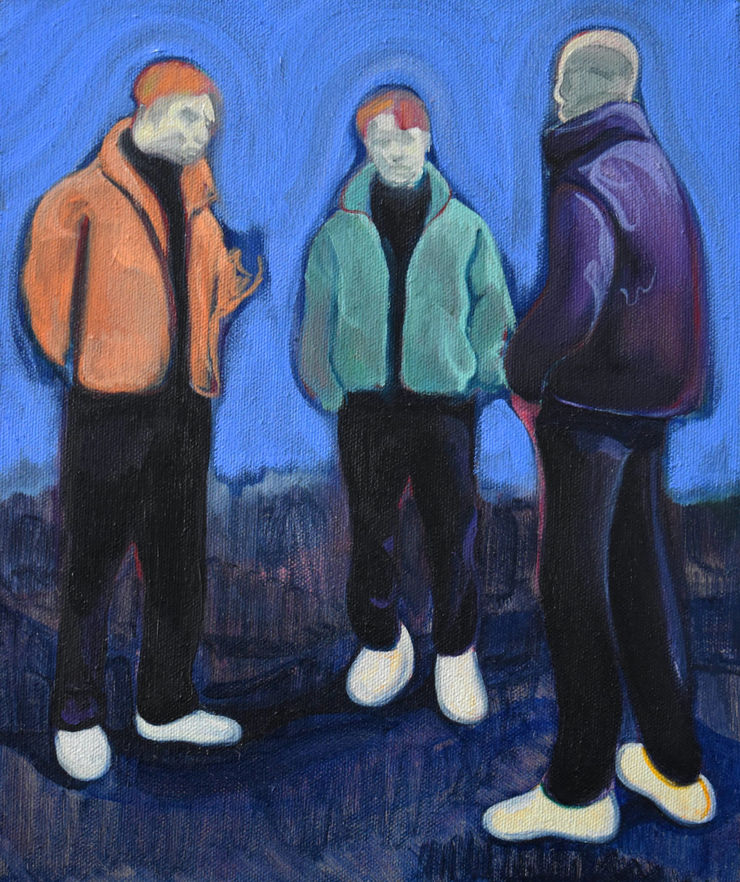
Will Fice British, b. 1999
-
Overview
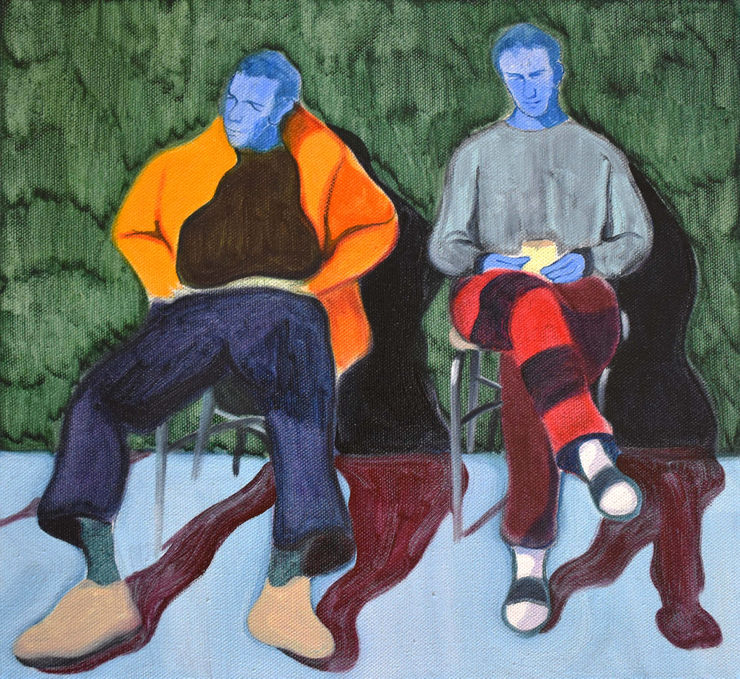
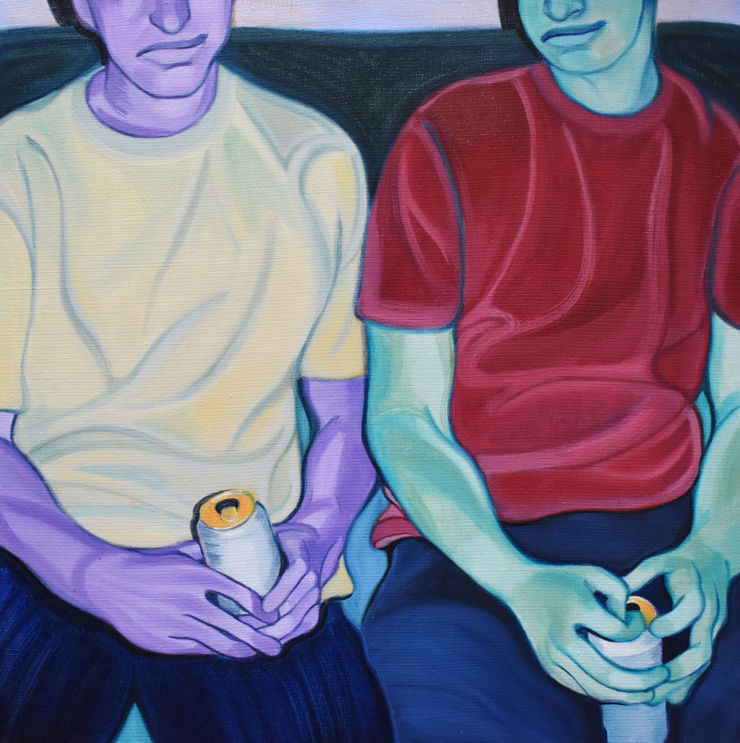
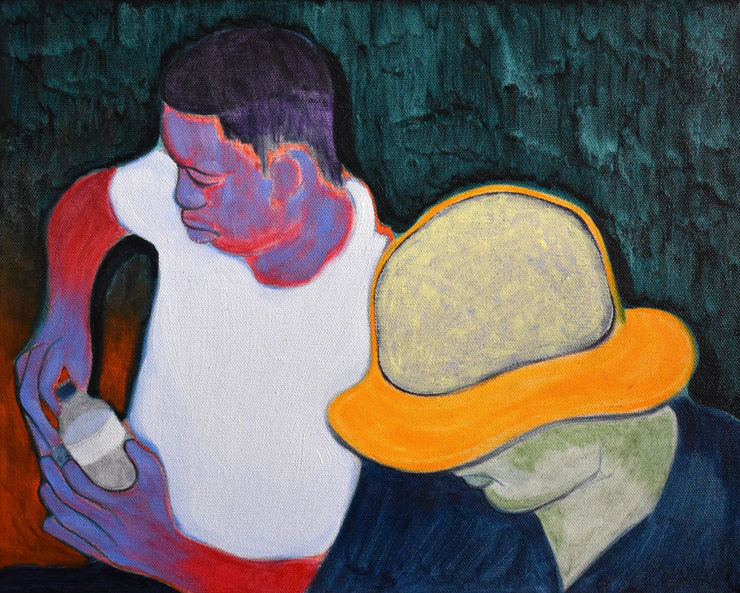
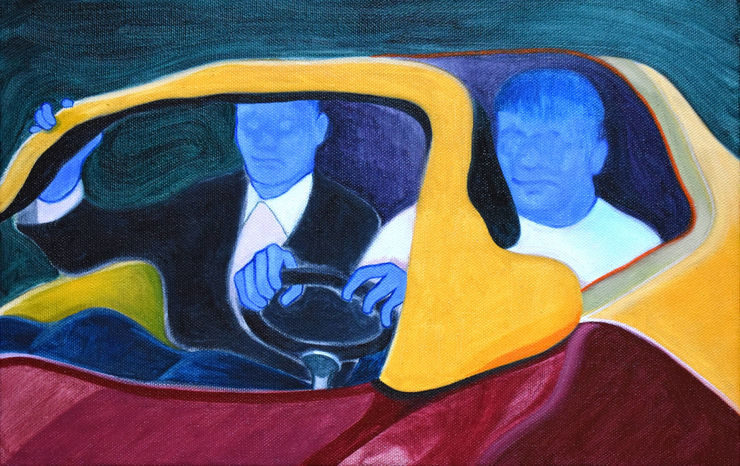
 Will Fice explores the dilemma of the adolescent on the verge of adulthood. Young men, "awkwards", are captured as they begin to reject the child and beckon the man. Friendship, appearance, demeanour, ennui and everything in between are addressed from a male perspective.WILL IS A BA (HONS) 2020 LEEDS ARTS UNIVERSITY GRADUATE
Will's source material is gathered from Instagram, chats with friends where photos have been exchanged, and his experiences and observations. The imaginary settings that his figures inhabit take on great significance. They have become pivotal to establishing and framing a narrative for the themes that run through the work.
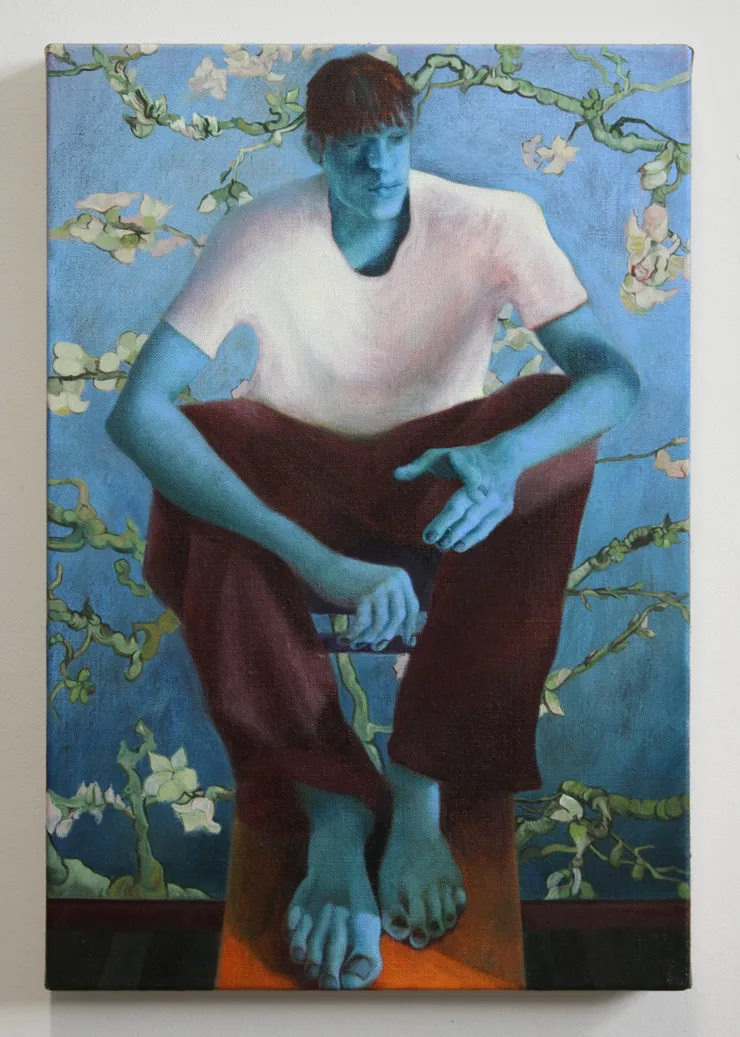
His deliberate use of a small canvas allows an intimacy of image that accentuates rather than diminishes the story. Drawing is essential and strong outlines are used to emphasise individual figures. Colour, too, applied as washed out or highly intense, helps establish a sense of character for the viewer.
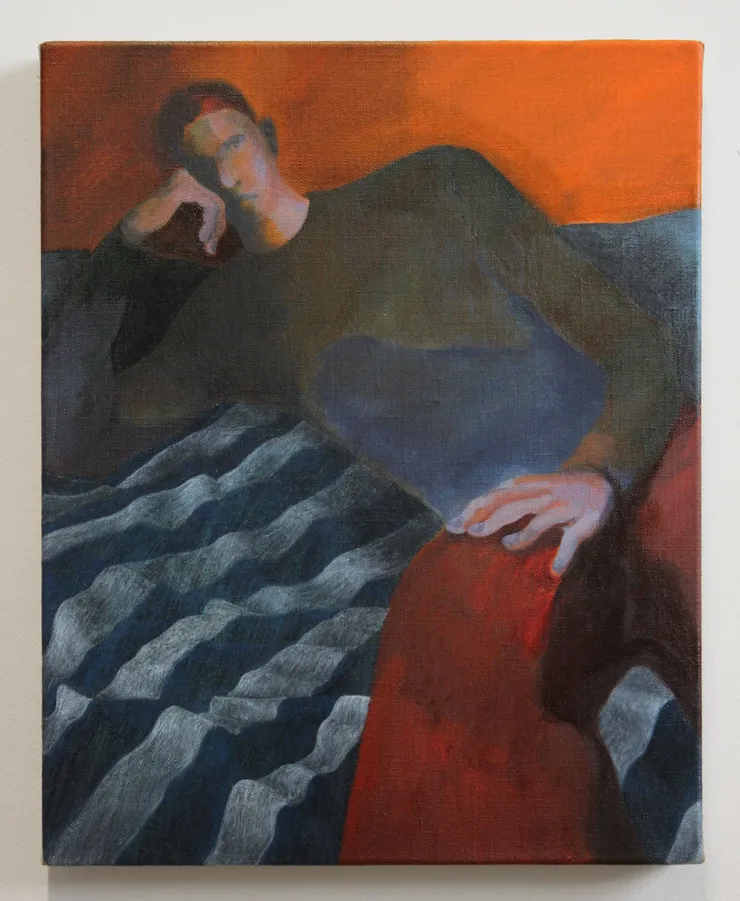
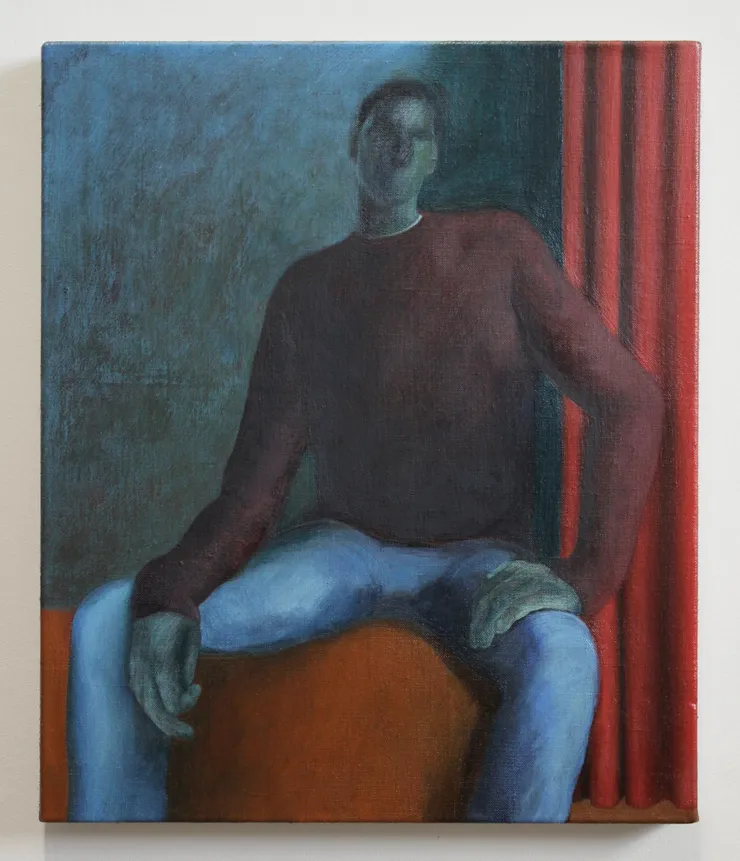
An exhibition of 10 new paintings opened in March 2025. Entitled ‘Can you Hear the Rain?’, the pictures focused on the representation of the single solitary male figure. The work continues to lend itself to ideas of male identity and significance, but now focuses on the individual. Each painting captures the figure, maximised within the border of the canvas; in a contemplative moment, either staring off into the distance or back at the viewer – separating itself from previous work which used scene to portray interaction between groups of young men.
£1,200-£4,500+ -
Works
-
Statement
My practice delves into self and manhood, using the liminal period between adolescence and adulthood as a subject to explore themes of identity and significance. The paintings invite the viewer into a recognisable space that is yet, forged and imagined, where young men imbued with adolescent ennui become painterly characters in a story that is never fully resolved. Where nostalgic memories merge with future anticipations; of innocence into experience.
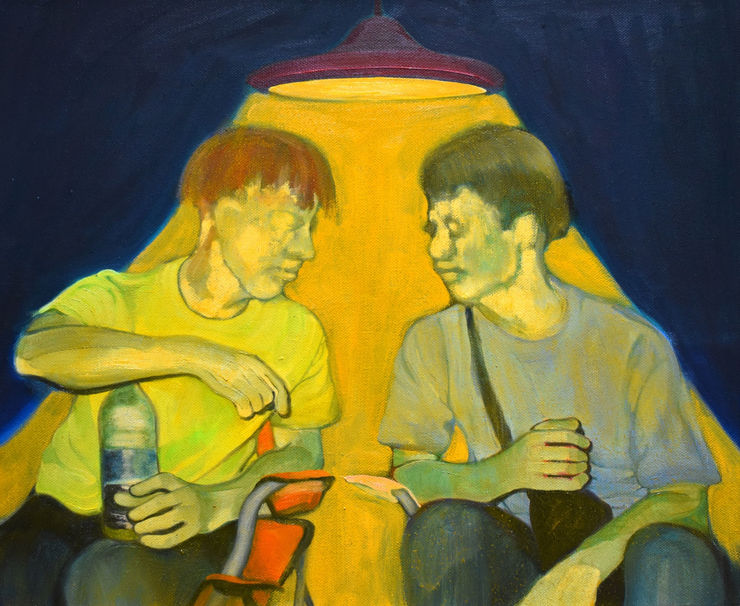
Piecing together material sourced from personal imagery and social media, intimate scenes of everyday interactions between friends are constructed concerning lived experience, art history, fashion and film. Paint is deeply layered and applied directly in both thin washes as well as thick accumulations of colour; repositioning what can be deemed as a fleeting, disregarded moment into one with significance and purpose. Figures lounge and loiter in space as a collective whole, not particularly doing anything at all. They act as organised and arranged structures against their environment to build narratives out of nothingness. Although intentionally curated, these scenes play out as natural occurrences, creating tension between the real and the imaginary. The resulting paintings carry enough absurdity and ambiguity to nudge the viewer out of a sense of reality whilst still keeping their feet firmly on the ground.
As the work has moved onto a larger scale, the composition has become more structured and concerned with the alignment of shapes and forms to create new narratives and perspectives. -
Essay by Matt Lippiatt
Can you hear the rain?Following a two-year hiatus, Will Fice returns with Can you hear the rain?, an exhibition of ten new paintings in which focus is shifted away from the male group dynamics that Fice has painted in the past, and onto lone individual men. The tone is more sombre than before, registering the impact of changing circumstances in Fice’s personal life – Fice recently became a father and lost his mother. Interaction is replaced by introspection, and this is carried over into formal choices: hue and pattern are reined back, in a deliberate push against the brightly coloured graphic style that Fice had employed in his previous exhibition, Beautiful Losers.Encountering the introverted figures in Can you hear the rain?, we might wonder if these are the same young men who populated Fice’s earlier work. No longer climbing trees or congregating in huddles, they appear to have parted and returned home alone. Together they killed time, smoked, drank, checked their phones – activities that could be continued individually, and yet all those activities are absent from the moments pictured in Can you hear the rain? We don’t even see a symbolic shadow or mirror image to hint at the multiplicity of a divided self. Instead, we’re presented with the human figure as a single self-contained unity, giving very little away. In the words of Aesop Rock: I pull my hood down, I got some walls up.Expression or introversion? Fice seems caught between the two, as the desire to communicate locks horns with an equally strong impulse to deflect and disengage. Bodies in these paintings are subject to distortion and heightened unnatural colour effects – the classic tools of expressionist painting used to convey heightened emotions by artists since the beginning of the last century (or further back still, if we include El Greco). But in Can you hear the rain?, these expressionist tendencies are held in tension by an unassuming body language of withdrawal. Arms are folded, heads turn away, and even the more open poses appear noncommittal. The only gesticulation in the exhibition is a single pointing finger, loosely gesturing beyond the frame, following the direction of the owner’s impassive thousand-yard stare.Fice taps into art’s mysterious and long-established connection between melancholy and elongation. We might ask: Why the long face?, as the very features that would usually clarify facial expression have been blurred into inscrutability. If eyes are the windows to the soul then these faces are mostly boarded-up buildings, with who knows what contained behind their blank facades. Most don’t appear to breath the air around them, nor do they disturb it by uttering a sound. They don’t see us, but we see them, which is the normal way of things with paintings, accentuated here with a curiously intimate sense of voyeurism. It’s like we’re watching someone sleep: so close, yet so far away.
Meeting the resistance of faces that are barely there, our attention falls instead to the hands, which are prominent in almost all the paintings here. Strong, large and heavy, they recall the sturdy working-class hands of twentieth century social realist pictures by Käthe Kollwitz, Ben Shahn, Peter Howson and Beryl Cook. But now these hands appear to be left hanging, evolved to grapple with a challenging material world, but increasingly made redundant by twenty-first century technology. (In this regard, there is a subtly optimistic synergy between these images of hands and the skilled manual labour that was required to render them on canvas – a quiet self-referential celebration of craft.) With nothing much to do, it is perhaps inevitable that these hands turn on themselves, picking idly at their own nails, or clasped in what might be an act of self-soothing.
Shortly before work on Can you hear the rain? was completed, the film maker David Lynch died. Fice doesn’t cite Lynch as an influence but there are striking parallels. Most obvious are the red velvet curtains that can be seen in two of Fice’s paintings here, and which were also a recurring motif in Lynch’s film and television work – especially Twin Peaks’ ‘red room’, an extradimensional zone where human characters where occasionally allowed to visit, sometimes in dreams, to interact with spirits. The red room’s velvet curtains appear to substitute for walls, creating an impression of somewhere uncannily familiar yet ominously undefined. Similarly, in Fice’s paintings the presence of red velvet curtains evokes an architectural space for the figures to occupy (“timeless and nameless places”, in Fice’s words), without nailing down exactly what kind of location this might be: public or private? A dressing room or a stage? Maybe neither. Any promise of theatricality seems thwarted by the men’s unwillingness to perform for us. There is feeling here, but no drama.
In the sparest paintings, Fice’s figures are set against nothing more than a subtly modulated colour field, like a photographer’s backdrop. The formal duality of figure and ground becomes a theme in itself, with the absence of environmental detail emphasising the figures’ introspective disconnection from their surroundings. Decorative patterns are allowed to inject rhythm here and there, but their careful rendering imbues them with an ornamental restraint. Meanwhile clothing and bodies are painted with an almost sculptural attention to the modelling of form, with one pose even recalling Rodin’s Thinker. This treatment conjures the illusion of physical presence, even as the smudging of faces insists on a more spectral passing through.
Passing through to where? Some of these paintings present settings that suggest home (or hotel) interiors, albeit distilled to a pictorial shorthand that looks back to Cézanne and the early modernist approach to surfaces that paved the way for Cubism. In these snug nooks, consisting more of painterly homage than observed reality, Fice renders clothes and soft furnishings to appear thickly enveloping, like things to take comfort in. He conjures for us a series of box rooms haunted by youthful ghost-faced occupants, striking an unusually warm melancholic chord with Björk’s 1993 hymn to solitude, Play Dead, in which she claims: It's sometimes just like sleeping, curling up inside my private tortures, I nestle into pain, hug suffering, caress every ache.
Matt Lippiatt, artist and freelance writer - February 2025
-
Will In Conversation
Patrick Davies talks to the artist prior to his successful solo show with the gallery in 2021
I first came across Will’s paintings through Instagram and a flurry of activity on Artsy. His graduation year from Leeds Arts was turned upside down by the Pandemic with the University closing. Left with nowhere to paint, he was forced to begin making work on a smaller scale from his bedroom. We met up, and I loved what I saw.
WHEN DID YOU REALISE YOU WANTED TO BECOME AN ARTIST, AND WHY DID YOU CHOOSE PAINTING? DO YOU COME FROM A CREATIVE BACKGROUND?
I didn’t seriously think about the prospect until my second year of university when I started to engage with my practice and my learning. I don’t come from a creative background, and I don’t have any relatives that have pursued a career in the arts or know anything about it. It wasn’t until I was put into an art school environment that I could start to build a hunger to make work and really begin to paint. In my first year of study, we were encouraged to experiment with different forms of art outside of what we’d previously been accustomed to. I remember just being very stubborn with the idea because all I wanted to do was paint. I didn’t want to turn my back on the medium when I was just getting started, and I believed there was a place for me within it. I just enjoy the act of painting and the freedom it offers. I like being left to my own devices where I can listen to music whilst I work and get lost in the process. It’s also the spontaneity of the medium where pretty much every time, mistakes and accidents dictate the final image.
2020 WAS YOUR GRADUATION YEAR FROM LEEDS ARTS UNIVERSITY, AND COVID CHANGED EVERYTHING. CAN YOU TELL ME ABOUT YOUR WORK BEFORE LOCKDOWN AND HOW THE PANDEMIC ALTERED YOUR APPROACH TO PAINTING, AND WHY? WHAT OTHER CHALLENGES DID YOU FACE?
I was using the same subject matter, but I wasn’t really happy with how It was being represented in paint. I was working on a larger scale, and my painting had become too predictable and systematic. These were very stylised but realistic representations that would directly copy the material I was referencing. I began working on a much smaller scale where I felt free to experiment and loosen up my use of paint. The lockdown meant the closure of the university, which caused the problem of not having a space to work from. I didn’t have much space to work from home, so I decided to abandon my work on a large scale and then double up on the number of small-scale pieces I was initially working on, which allowed me to expand on my material and the language I was developing with each piece. Prioritising a smaller scale as a result of the pandemic meant I had to reconsider technique. I had initially planned for the work to be even looser and less refined. In terms of my painting process, time was a thing I had to adjust to as I would complete work at a much faster rate, rotating multiple pieces at a time. I also liked the level of freedom from working in complete isolation compared to the communal studios provided at University, and I don’t think without the lockdown, my work would have taken this direction.
WHAT IDEAS OR STORIES ARE YOU TRYING TO CONVEY? IS IT IMPORTANT HOW THE VIEWER REACTS TO YOUR WORK?
I’m interested in sharing a perspective of young manhood from my experience, a coming of age. In doing so, you could say I’m trying to convey the shared guardedness within groups of friends, a sort of inner circle where figures coalesce and confidently occupy space across a canvas. I want to express a state of profound boredom. Finding yourself within a specific environment, performing certain behaviours due to boredom and little money. Within that, there has to be a sense of freedom and carelessness. The work is very much about the now and the moment, but naturally, there’s a sense of uncertainty; what will the future hold for the figures represented, and where will they go next? Will these relationships continue or fall to the hands of time as we get older? The things I’m trying to convey must be reflected in the work so people can draw an understanding. However, I don’t paint to try to get a reaction or try to make the viewer feel a certain way. It’s ultimately up to the viewer to react and interpret the work.
THE INDIVIDUALS AND GROUPS THAT YOU DEPICT ARE EXCLUSIVELY MALE. WHY?
The work strictly dominates a male perspective because it comes from a place of lived experience, a reflection of myself. The figures depicted are exclusively male, as the work follows the relationships between young men and moments between friendship groups. At this point, it’s what I know and respond to the most. I’m interested in self-image. How others perceive us and how we want to be perceived through our appearance, dress sense, body language and behaviour. It creates a dialogue about the type of relationships between the figures in the work and is something I wanted to reflect in the painted image.
DOES YOUR IMAGERY COME FROM DIRECT EXPERIENCES, OR ARE THEY IMAGINED? TELL ME MORE ABOUT THE PEOPLE DEPICTED; ARE THEY FRIENDS? ARE THE SITUATIONS SPONTANEOUS OR PLANNED?
The imagery comes from direct experiences, some of friends and some from different sources. A lot of the moments are spontaneous and candid. I like it where figures are caught loitering in space where each figure performs something different across a composition, almost waiting for something to happen.
WHAT PART DO SOCIAL MEDIA AND PHOTOGRAPHY PLAY IN YOUR CREATIVE PROCESS?
I primarily use Instagram to gather imagery. However, I also find a lot of useful images flicking through old photos on my phone and group chats where photos have been exchanged between friends. I spend a lot of time looking for material and eventually gather a wide selection before singling out the most suggestive images that allow me to cause a reaction in paint.
HOW IMPORTANT IS YOUR USE OF COLOUR, WHICH CAN BE BOTH INTENSE AND WASHED OUT?
I’ve always been attracted to colour across all forms of art. With my most recent work, colour has been something I’ve had to think about more than ever. Well, actually, I’m kind of contradicting myself because when I’m in the process of painting and applying colour, I don’t really think. I’m quite intuitive in my choices and also rely on chance and accident. From there, I’m able to decide what colours react well with each other and what a painting could be missing. I think what I mean when I say I’ve had more to think about involving colour is asking myself what representing the material in such saturation is doing for the image. For me, it’s about bringing attention to these otherwise mundane scenes and accentuating the self-image of the figures. The resulting paintings are loud in tone. The colour adds feeling to the images and opens a window to a different, more inviting space.
YOU OFTEN USE STRONG OUTLINES TO ACCENTUATE CHARACTERS. IS THERE A REASON FOR THIS?
It works in accentuating the figure, movement and the body languages that are being performed, as well as providing a structure to the flat plains of colour. I was initially influenced by the Edvard Munch painting; Melancholy (1894) and Peter Doig’s Lapeyrouse Wall (2004). Drawing plays a significant role in my painting, which can also be said to be reflected in my use of outline.
HOW IMPORTANT IS SCALE? THE SMALL CANVASES CREATE AN INTIMACY WITHOUT IMPINGING ON THE GREATER NARRATIVE OF THE WORK.
The smaller scale is important for maintaining the intimacy of the imagery and a balance between the photographic and painted image. I thought the type of material is more suited for a smaller scale as these images are not fully fledged scenes. They’re spontaneous and somewhat meaningless moments. They’re fleeting snapshots in time. I don’t see them as something so significant and important to the point that they should be presented on such a grand scale. At this point, I like how the work operates as small icons, where a vast array of images can be displayed together at once, and the significance of the imagery can be spread across a body and not one unified image.
WHICH OTHER ARTISTS DO YOU ADMIRE AND WHY? DO ANY DIRECTLY INFLUENCE YOUR WORK?
I admire many artists; I spend a lot of time looking at art on Instagram which I think can unconsciously filter into your work. I’ve been looking at many of Nicole Eisenman’s paintings and, more recently, Florian Krewer. Peter Doig, and R. B. Kitaj have had a direct influence on my painting stylistically as well as Gauguin and Munch. I was initially inspired by Doig’s studio film club posters for the looseness of the paint and use of colour. Kitaj has also had a direct influence on my use of outlines. -
Film
-
Beautiful Losers
a short documentary film by nick marrington to accompany will's solo exhibition 'beautiful losers' -
Waiting Room
IN THIS 'SELFIE' FILM, MADE ON AN IPHONE IN HIS BEDROOM, WILL DISCUSSES HIS WORKING PRACTICE THROUGH THE IMAGERY OF THE PAINTINGS INCLUDED IN HIS 2021 SOLO SHOW 'WAITING ROOM'.
-