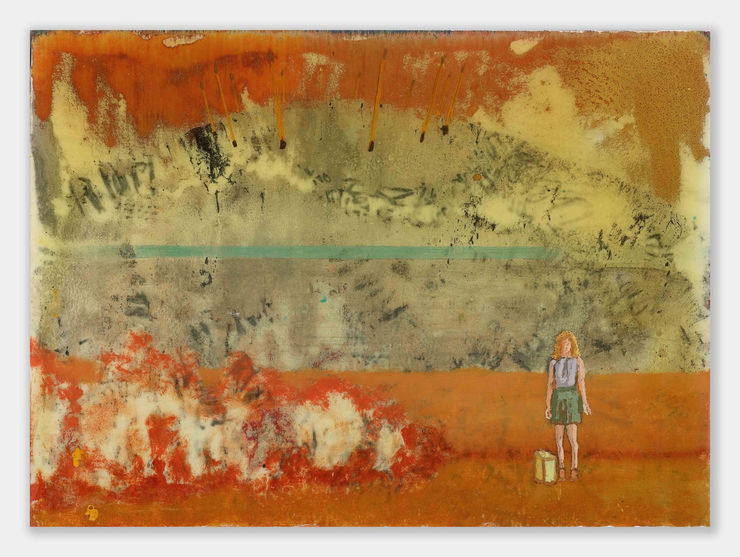
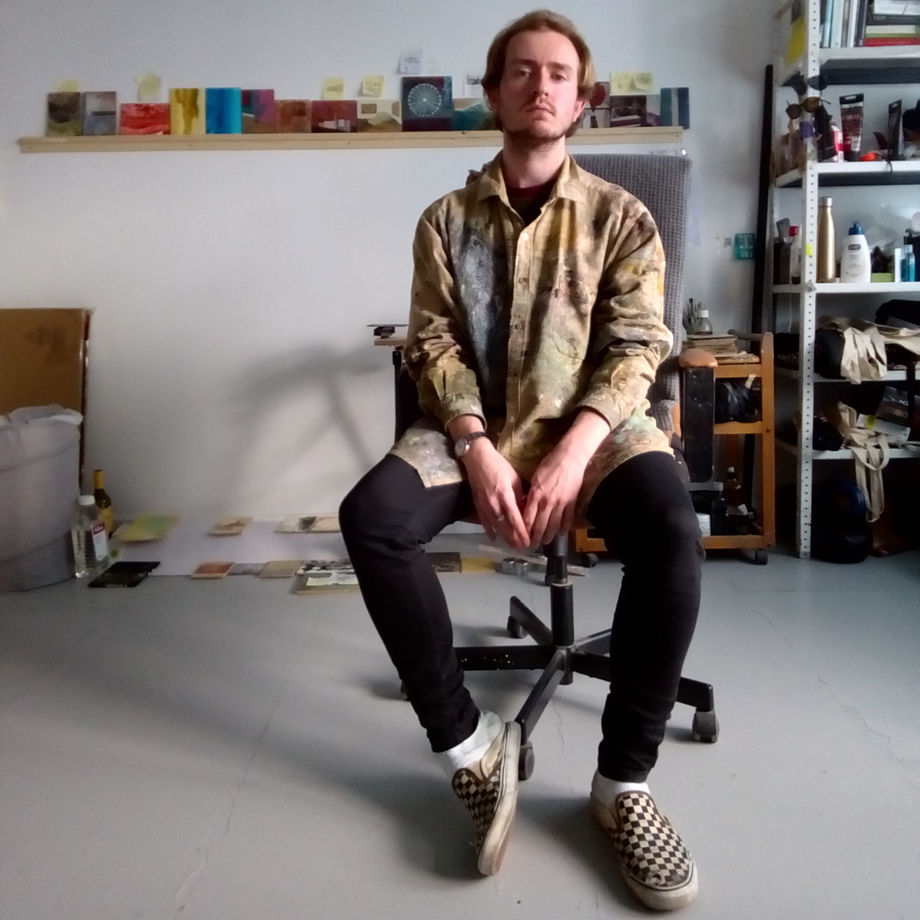
Jack Dunnett Scottish, b. 1995
-

-
Paintings
-
Jack Dunnett, A Little Souvenir, 2025
-
Jack Dunnett, Nothing Ever Happens, 2025
-
Jack Dunnett, Aspiration and Floundering, 2024
-
Jack Dunnett, A Big Hole, 2024
-
Jack Dunnett, Exchange of the Tempo Eating Night, 2024
-
Jack Dunnett, Hedgehog Dilemma, 2024
-
Jack Dunnett, Tell Your Sister, 2024
-
Jack Dunnett, Thirty Love, 2024
-
Jack Dunnett, Born for This, 2023
-
Jack Dunnett, Ratlands, 2023
-
Jack Dunnett, The Crossing, 2023
-
Jack Dunnett, How Did We Do Today, 2023
-
Jack Dunnett, Before The Bathwater, 2023
-
Jack Dunnett, Following the Fun, 2023
-
Jack Dunnett, Self-worn Us, 2023
-
Jack Dunnett, Salt and Batter, 2023
-
Jack Dunnett, Spectacle, 2023
-
Jack Dunnett, Reeking of Sound, 2023
-
Jack Dunnett, Quaking Aspen, 2022
-
Jack Dunnett, A Windfall So Stratospheric It Heavies the Heart, 2021
-
Jack Dunnett, The Comfort of the Morning - nfomercia, 2020
-
-
Artist Statement
Jack Dunnett is a painter who merges techniques of traditional oil painting with explorations into reactions between household chemicals, building materials and found pigments. Working with processes which build up and strip away layers, he creates paintings which examine relationships between prescriptive mark-making and chance elements, combining structure and chaos to create scenes which hold themselves in a state of balanced tension. Depicting stories from an unreliable narrator, the building and redacting of each surface references the flawed and grasping nature of memory and perception. The subjective lens through which thoughts and events are experienced is captured by an unyielding ambiguity of scenario, spun through processes of obfuscation and revelation. This culminates in a picture which presents itself as informative yet questioning, demanding that the image be filtered again by the eye of the viewer."..for me the way events, stories, myths, and memories evolve in passing through not only the oral tradition, but through documentary and artistic depictions is always interesting to scrutinise. It's like a perpetual wheel that turns not metaphorically - untouched by intervention - but like a physical rolling stone in travel. On the journey it is inevitably affected by atrophy, addition and distortion caused by the surfaces over which it rolls, losing chunks and gaining layers. The framing of stories at the point of telling is often more indicative of the countless storytellers than it is of the event it claims to depict.”Finely detailed, intimate sized pieces on boards, the paintings bear heavy adornments of materiality, containing twisting forms caused by chemical reactions, and sculptural textures reminiscent of a variety of stones. Pockets of glaze and varnish draw the eye around the paintings; arranged embellishments which encase flecks of a crafter's trait among chance elements. Conscious painterly marks are juxtaposed with these formations, allowing the intervening hand of the artist to converse with the permanence of the more elemental furnishings. Figures either meld or jar with their environment, the characters aware they are acting in a perpetually staged scene. -
Jack in Conversation
Patrick Davies Talks with JackWHEN DID YOU REALISE THAT YOU WANTED TO BECOME AN ARTIST? DO YOU COME FROM A CREATIVE BACKGROUND?
I've always drawn for as long as I can remember. Getting ideas onto a piece of paper with marks seemed intuitive and a direct way to try and put something tangible to the things going on in my imagination. I'm an only child, and I remember when staying at my grandparents' cottage at weekends, my grandmother let me draw on this Woolworths A4 notepad she used for shopping lists. I saw where she returned it to afterwards and would take it out to continue drawing tiny little images smaller than a playing card, and once I lost interest in whatever the idea was, I turned to a nice new clean sheet. I soon used every page in the book, and she bought me a drawing pad of my own. When I was slightly older, maybe from around five or so, my father would set aside half an hour where we would draw together in the evening, this time sketching actual things from real life or memory. I could easily be kept quiet and entertained by paper and a pencil. I didn’t understand the point of colouring books because of their prescriptive nature. Using a set number of colours to fill in someone else's picture was boring and pointless to me as it would end up looking pretty much the same as it did before. Art classes at school, where everyone had to make something like a hand-print turkey, were of no interest. Everyone’s always looked the same, and it seemed a severe waste of time. I never realised that I wanted to be an artist because, as far as I was informed, it wasn't a job. You couldn't apply to be an artist and get a salary. I was aware that there were people in the past who were artists, but of course, they lived far away and died poor. I knew there were people locally who made art, but apparently, they did it as a hobby and worked a 'real' job to get money. I was told that some artists could make a living from their work, but they were one in a million, and the clear implication was that I was not. I only found out that at fifteen, that art school was a thing that existed. So, I decided to apply.WHERE AND WHEN DID YOU STUDY AT ART SCHOOL? WHAT WAS THE EXPERIENCE LIKE? WHAT DID YOU LEARN?
I studied Painting at Gray's School of Art in Aberdeen from 2013 to 2017. Being from asmall town in the far north of the Highlands, Aberdeen was very much the big city for me and an exciting prospect. The buildings had more than two storeys, and shops were open on Sundays. There were even two Wetherspoons', and multiples of every different kind of supermarket, some even open 24/7. I had moved to a bright orange breezeblock prison cell with seven strangers and one fridge in a compound of hundreds of other students raring to make their own mistakes. It was brilliant. It was such an odd, choppy experience, though, attending art school at eighteen. I vowed to be open-minded and try to dip my toes in every area of study. In the first year, we all had to do a generalist course which involved studying things like fashion, architecture and communication design, which I already knew I had little interest in. Even the one day a week we had of life drawing seemed just to involve sketching a pile of chairs and easels set up in the middle of a hall. At the same time, tutors from all different departments would walk around and whisper contradictory information in your ear. I decided my time would be better spent doing independent study for most of the week. I spent my days going around Aberdeen’s old pubs and dive bars with my sketchbook, a book to read and my music player. I'd spend my student loan on pints of heavy and sit in a corner drawing and writing, listening to music and people. There was a certain honesty and lack of pretence to those I'd meet, and that was such a contrast to art school with the students pretending to be adults and the tutors who had the gall to claim that making a giant model of a clothes peg out of cardboard boxes would 'feed into our creative practice’. Before I went to art school, I naively imagined it would be a caricature of a place, a sort of free-for-all of encouragement and creative expression. It turned out to be a far more structured affair, for the first two years at least. After that first year, I began to concentrate properly on my studies and show up to the studio as I now had a space of my own. Having the time and the space to work and having artists as tutors imparting their knowledge was invaluable, and I knew it wasn't to be taken for granted. Whether it was advice that deeply resonated with what I was searching for or disagreements about specific approaches, it allowed the possibility for growth if taken in the right way.
WHAT ARE THE MAIN INSPIRATIONS FOR YOUR WORK?I draw a lot from stories and the paint's physical properties. When it comes to subjects for paintings, they're informed by a steady stream of influences that come from many sources. The films I watch, books I read and music I listen to all feed in alongside memories, musings and day-to-day experiences. I see as much art as I can and tend to be drawn to small details of texture and colour. Marks that convey the hand of the artist often grab my attention and make me think about the degree of control the artist can have over the materials and what level or expression is most appropriate to convey the subject. I have countless areas of inspiration. I dart between them so frantically that I'm often not immersed deeply in one particular subject but find myself skimming between something that links multiple interests. Stories and how we interact with them; the mundane and the transcendent; signs and symbols; honesty and allegory. The only constant is that feeling that doesn't go away, that says 'this painting needs to be painted’. I'm interested in the documentary, the human element of how events or stories are told by the person capturing them. Filmmaking, for example, varies drastically and has noticeably changed over time due to different sensibilities and motives. A documentarian has the choice of delivery of their subject, from a cold, matter-of-fact articulation which values subjectivity through to using musical and narrative interjections to affect a specific area of emotional response from a viewer, aligning them with the viewpoint of the artist.HAVE YOU ALWAYS WORKED ON A SMALL SCALE? HOW IMPORTANT IS THIS TO YOUR CREATIVE PROCESS? DO YOU WORK ON PAINTINGS ONE AT A TIME OR IN SERIES?
Working on a small scale has gifted me a lot of discoveries, none of which I anticipated or sought out. I first began making small paintings in my final year at art school. I had an overarching outcome in the back of my mind for what I wanted my degree show to be in the years before I even began thinking about the practicalities of it. It needed to be on a large scale involving a scene on a 2x4 meter canvas, encompassing many figures which showed a modern narrative in a grandiose Romantic setting, reminiscent of a Turner or John Martin painting. Over time, however, while making individual character studies for these large works, I found that I wanted to explore these snippets in more depth, keeping them self-contained yet involved in an ongoing narrative. The Romantic paintings I had been studying may have deployed many figures in a large painting, but that tended to emphasise the fundamental proponent ideals of what Romanticism was yearning to achieve in its time, the diminutive form of human within nature, and nature as the signifier of overarching divine superiority. I felt the characters I had been delving into needed their own platforms, which were more conducive to our contemporary situation. Isolated characters were explored in depth as part of a larger whole, yet eternally separated from it. Each piece is set in its own amber, to be looked at alone, defined by its own edges and limitations, yet continues to be part of the larger overarching body of work. Characterised by the grounded limitation of edge, restricted by their four walls, yet linked with a serial bond that they will be forever unaware of. Working intimately on small boards has led me to a process I wasn't conscious of until I had to think about it. I work on paintings while holding them in my hand or balanced on my fingertips. It allows me to immediately change the angle I'm working at without adjusting an easel and to move around the studio as I work, seeing the piece in a different light. My palette is on wheels, so I just roll it around the room with me as the light shifts. When I've taken a piece as far as I can go with it intuitively that day, I'll place it down and start working on another picture. I've found this the best way to avoid any creative blocks or dead ends in resolving a painting. I work on up to fifty paintings at once. All take a long time to complete, but I find this rotational working stops anything from feeling monotonous or laborious.
THE TECHNICAL SIDE OF YOUR PRACTICE IS IMPORTANT, OFTEN COMBINING TRADITIONAL MATERIALS WITH OTHERS NOT NECESSARILY ASSOCIATED WITH PAINTING. WHAT ARE THESE, AND HOW ESSENTIAL ARE THEY TO THE FINISHED WORK?
I've come to utilise a short list of household chemicals in my work just as much as any particular oil colour. They all stemmed from heavy-handed experimentation with materials when I was at art school and worked part-time in a hardware shop. Behind the counter was this laminated sheet of pictures of different problems people would encounter with paint if misused, things like 'surfactant leeching', 'rippling', and ‘blistering'. It reminded me of the books you'd get in high school that showed photographs of painterly techniques; 'scumbling', 'sgraffito', 'impasto' etc. I brought this knowledge to the studio, along with discounted burst bags of building materials, defective tins of paint and various volatile industrial chemicals. I've pared these down over the years, as the first experiments occasionally resulted in inadvertently burning a hole in the studio floor, accidentally synthesising chemical weapons and creating paintings which were 'hot to the touch' and couldn't be exhibited for public liability reasons. All these initial compounds are gone from my work. However, looking up their less powerful chemical counterparts has led me to certain salts and light acids, which significantly affect the patina of a lot of my work. I've learnt that the bones of the piece still needs to be the paint, but there are a lot of domestic paints, which I find a lot more hard-wearing and effective than the most expensive oils. For example, liquid rubber used for roofing makes an excellent deep matte black. I also paint it on my boots to keep them from letting water in the cracks. Some brands of plaster used in the trade are much stronger than artist's plaster and can be used to make fresco-type pieces which can stand the test of time. The best way to get the effect of a cement wall in a painting is to use cement.
WHICH ARTISTS DO YOU ADMIRE AND WHY? DO ANY DIRECTLY INFLUENCE YOUR WORK?
There's a lot. Philip Guston, Rose Wylie and Louise Bourgeois for the way they talk about painting. Antoni Tàpies, Anselm Kiefer, Kai Althoff and Merlin James for their use of materials surrounding painting. Hopper, Vuillard and Turner for their use of colour. Walter Sickert, Andrew Cranston, Norbert Schwonkowski and Frank Auerbach for their manipulation of paint. Emin, Munch, Schiele and Bacon for their rawness and honesty. Caspar David Friedrich, Carl Spitzweg and Carl Gustav Carus for their compositions. They've all influenced my work directly to some degree. I like how certain filmmakers talk about creating images and working with narrative. Charlie Kaufman and Tarkovsky write excellently about the process and the thoughts behind them, and they speak in terms which often cross over with painting. Many performers, comedians and musicians also talk so well about the creative process that I take a lot from their words: Patti Smith, Stewart Lee, Nick Cave, and Aidan Moffat. I'm a sponge when listening to folk talk about their work. The feeling of a shared experience in the arts, however much I can relate to it or not, is always cathartic.
-
Julian Spalding Essay
Written to Accompany Jack's Exhibition 'Edgelands' with the gallery in 2025Julian Spalding is a former director of art galleries for Sheffield, Manchester and Glasgow. He established the Ruskin Gallery, the St Mungo Museum of Religious Art and Life, the Gallery of Modern Art Glasgow and the Campaign for Drawing. His many books include The Poetic Museum, The Eclipse of Art, The Art of Wonder (winner of the Sir Banister Fletcher Prize 2006), Con Art, The Best Art You've Never Seen, Realisation and, with Raymond Tallis, Summers of Discontent.
EDGELANDS
It's a delight to see the art of painting re-emerging. There were times when I thought I'd never live long enough. But now it's happening. Merlin James, Sourav Chatterjee and Jay Rechsteiner are just a few of many names to conjure with in this renaissance. Andrew Cranston is another. And now Jack Dunnett, one of the pupils Andrew taught at Grays School of Art in Aberdeen is beginning to flower with a very distinctive voice of his own - a visual voice, purely in paint, which is not at all easy to describe in words.
A bit of context helps, a bit. Jack Dunnett was born in 1995 and was brought up in Thurso, a small town on the most northern tip of mainland Britain, where the ferry leaves for the windswept Isles of Orkney. His art gives the impression that he has always felt that he exists on the extreme edge of … I was going to write of everything, but that would be too simplistic. But then everything I start to write about Jack Dunnett's work I find to be too simplistic. Even his name. I was tempted, just now, to write 'Jack's work', but that would sound too personal and familiar. But referring to 'Dunnett's work' is too formal. His work is both individual and detached, so using his full name is more apposite.
Back to the edge … of what? The edge, perhaps, of himself. His paintings are purposefully ambiguous. They spring in part from personal experiences but he wants these to remain inaccessible to the viewer. Yet at the same time he doesn't want the viewers to feel locked out but free to explore the piece and find in it what they will. This is an invitation and a distance. It is fundamentally true, too, of all human relationships, however intimate. We are each ultimately alone, however much we love another. This is the solitariness one senses in all Jack Dunnett's painting. It is, one feels, one reason why they are so small, and the edges of each image are so important to the whole.
More facts. He can't remember when he didn't draw. An only child, his grandmother bought him a sketchbook when he drew on all the note-pads she used for shopping lists. From the age of about five, his father drew with him for half an hour in the evenings, pictures from life or their imaginations. He went to art school, not because he thought there was any chance of earning a living as an 'artist', but because he didn't know what else to do. He studied at the most northerly art school in Britain - another 'edge' - one of the few left that taught the techniques of painting and drawing. And, from there, he has never looked back.
Visiting Jack Dunnett in his studio is an unforgettable experience. The silence around his thin, delicate form is almost palpable. He gives the impression of being haunted, quietly but relentlessly. This stillness is emphasised by the smallness of his studio, one of several - most presumably much larger - in a multi-storied artists' workshop complex near the city centre of Glasgow. You are immediately aware of a mind at work. There's a shelf of books in the corner by the window: volumes on his favourite artists, like Anselm Kiefer, Phillip Guston and Caspar David Friedrich, interleaved with books by Carl Jung and one by Freud. All look well-thumbed.
There is mess, as you'd expect in a workplace, but even this is contemplated. Tubes of oil paints are hung up on clips in neat rows on the wall, top-down, ready for pressing from the end. Next to them are colour charts, post-notes and postcards of paintings he admires, among them a Schiele, Sickert and a Bacon. His painting trolley below is like Bacon's own studio in miniature, an explosive riot of paint, pots and brushes, and across his pallet, which is encrusted as thickly as an Auerbach, lies a builder's scraper, hinting that we are in the presence here, despite the order, of no ordinary, orthodox painter.
To help pay his way through art school, Jack worked part time in a hardware store and became fascinated by the much rougher, tougher painting and decorating materials used in the building trade, far from the refined world of artists' oils, acrylics and watercolours. A chart of what can go wrong with household paints if they're misapplied, showing effects of leeching, rippling and blistering, gave him ideas. He didn't want to create art in a precious, let alone a pristine environment. So, he began to use raw materials, like cement and liquid rubber used for roofing and all manner of potentially dangerous chemicals. The chance effects of their applications inspired him, just as anyone has to responded to the random, disconnected incidents of ordinary life. These tough backgrounds give his little paintings scaffolding and guts, but the spirit that flows through them still come from the tubes of artists' colours hung so neatly along his wall.
So, what's the result of this explosive conjunction? This is even more difficult to write about. Take the painting called The Well Worn Path of 2024. No one reading these words would expect to see a painting of a woman sitting in an armchair watching TV, which is what it is. His art is not, in that sense, at all literary. His titles are added later - they're more like associated but independent thoughts. There are lists of them hung on the wall, near his paint tubes. They read like poetry in themselves: Vinyl Frontier, Wishful drinkers, I'm eating my head, Here come the cowboys, The art of being a canvas, Flowers for hours, The sun always smells on TV. Some are crossed out; they might have been used, or become defunct.
And yet the title The Well Worn Path is literal in a sense. The picture is painted on a surface of tattered, scumbled and scraped paint that looks exactly like a worn, threadbare carpet - hence the literal accuracy of the title. This basis provides the painting with its silent, moody atmosphere, in which a woman sits idly watching the TV screen. The fact that the TV is lit but has nothing on it - the luminous opacity of a blank screen has been beautifully rendered in paint - and the light from it that catches just the edges - edges again - of the woman's face, flesh and clothes, as well as the deep claret red of the wall behind which is contained, by implication, in the dark green bottle beside her green armchair - all of these touches of paint add other dimensions of implications to the painting's title.
The Well Worn Path is a painting about a state of mind, in the same way that Sickert painted images of boredom. But to write that this little painting is about 'the meaning of a sense of meaninglessness', which in many ways it is, sounds tricksy and superficial, which the painting itself isn't, not at all. Phrases like this pat it and you on the back and say 'that's it'. They are dismissive, and allow you to move on. But this painting doesn't. It makes you want to go on looking at it. This is why writing about Jack Dunnett's is so difficult and deceptive. Words aren't right; looking is everything. He paints pictures that are alive, that you want to go on living with.
And as you go on looking at The Well Worn Path, you notice the precision of the composition, the placing of the empty screen and the upright bottle (vertical features are vital elements in Jack Dunnett's art) and the angle and hue of the skirting board. These elements go on singing whenever you look at them. His paintings are lasting, in the same sense that poems are lasting. They are feelings and thoughts woven together so intricately and cleverly that they hold the fleeting moment still, as if in the palm of your hand. This is one reason why they are so small. He paints them like this too, he told me, holding the one he is working on in his hand, as he walks around the studio, looking at it from different angles in the changing light. So, his paintings hold time still, but they do this purely visually, not verbally. They are poems in paint, sensations that have to be painted, for there is no other way to contain them and express what they might mean.
Even more significantly, Jack Dunnett's paintings are of now, condensations of what it really feels like to be alive today. They are works of art, not propaganda, pared of all hopes, however worthy, of what life ought to be. Here there is nothing woke. His paintings just try to get as close as possible to what life actually is. All his paintings are contemporary. They are replete with memories too, but then the present always is. One beautiful little painting I saw in his studio - not yet titled - shows in the background a modern housing estate over a slatted fence - very evocative of my own childhood, as it happens. The windows look like eyes all looking to the side, and one is broken - a black burst in white. An improvised goalpost is painted on the fence - a favourite repeating motif in his art - even games are temporary - but below is a primeval swamp, looking global in its scope. A boy jumps into it - what kid can resist a puddle? - while his shadow on the white water, dances, Matisse-like, with joy. This is memory in now.
Though we can exist only in the present, we are facing backwards in time for none of us can see one minute ahead. Jack Dunnett's paintings are about that: our current and past sensations viewed within the context of our awareness of the inevitability of sweeping change. His most delicate brushstrokes indicate the former, while the latter is evoked by the primal chaos of his building-material bases. When I visited his studio there were a dozen or so of these differently coloured little bombshells lying on their backs waiting to be painted, acted or danced upon, often by figures looking further into the picture, not out. He told me he can work on up to fifty of these tiny panels at any one time - watchful for the moment when one demands to be painted - such is the wealth, breadth and depth of the inner sensations he is mining. And he's only just beginning. One can't help but think there's a cave of wonder still to come.
-
Film
Made by the artist film made to accompany his 2025 solo exhibition 'Edgelands'Film
-
Biography
BORN SCOTLAND 1995
SOLO EXHIBITIONS2025 Edgelands, Patrick Davies Contemporary Art, London
Embrace the Bliss of Humdrum Days, Le Clézio Gallery, Paris
2023 Catatonia, Arusha Gallery, Edinburgh2022 Damn Idle Eyes, South Block, Glasgow
2019 Metanoia, Arusha Gallery, Edinburgh
2017 Ouroboros, Aberdeen Art Centre, Aberdeen
SELECTED GROUP EXHIBITIONS
2023 Eye To Paper, Edinburgh Palette, Edinburgh
2023 Some Bright Young Things, Brown's Gallery, Inverness
2023 Völliger Rauch, Galerie Bernsteinbereich, Berlin
2021 Cruel Intentions, Arusha Gallery, London
2021 10+1, Contemporary Six, Manchester
2020 Resonant Strangeness, Marram Arts, Online
2020 Reaching Out, SCA, Online
2020 FLOW, Visual Arts Scotland, Online
2020 With Love, Paint Talk, Online
2019 SSA + VAS Open, Royal Scottish Academy, Edinburgh
2019 Winter Exhibition, Gallery Heinzel, Aberdeen
2019 Cont., Young Artist Award Exhibition, Biscuit Factory, Newcastle
2018 Exemplars, Amber Range Gallery, London
2018 Veil, Arusha Gallery, Edinburgh
2018 New Contemporaries, Royal Scottish Academy, Edinburgh
2017 New Faces, Gallery Heinzel, Aberdeen
2017 82nd Annual Exhibition of Caithness Artists
2017 Best of Degree Show, Six Foot Gallery, Glasgow
2017 RSA Open, Royal Scottish Academy, Edinburgh
2017 Gray’s Degree Show, Aberdeen
2017 Whatever Sticks, – Kuku Klubi, Tallinn, Estonia
2016 Fly, Visual Arts Scotland, Royal Scottish Academy, Edinburgh
AWARDS
2018 RSA David & June Gordon Memorial Trust Award
2017 RSA Keith Prize – Best Work from a Student at a Scottish Art School
2017 RSA: New Contemporaries Selected Artist
2017 ACT Aberdeen Graduate Award
2017 ENGIE E&P UK Ltd Scholarship and Purchase Prize